

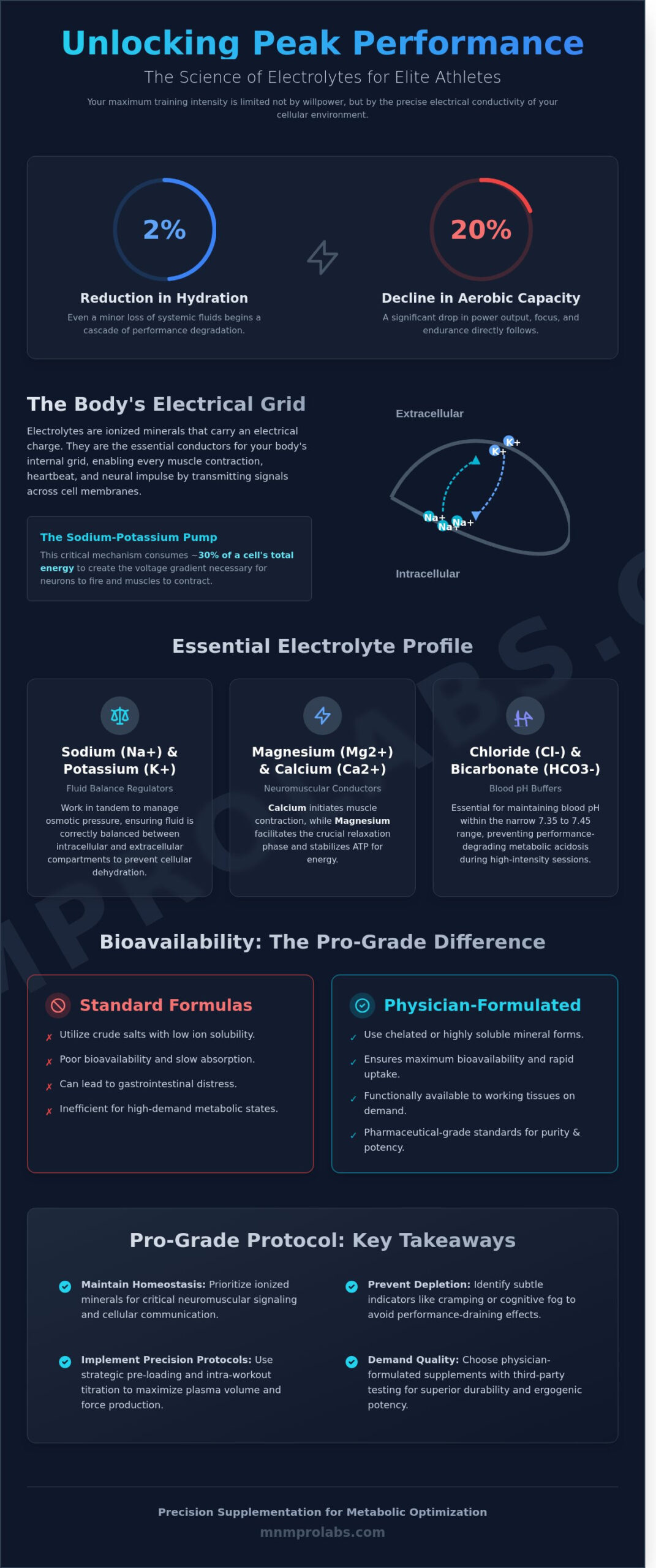
Your maximum training intensity is limited not by your willpower, but by the precise electrical conductivity of your cellular environment. It’s a physiological fact that a 2 percent reduction in systemic hydration can trigger a 20 percent decline in aerobic capacity. Without a calibrated balance of electrolytes, your nervous system’s ability to signal motor units effectively becomes compromised. This leads directly to the performance plateaus and cognitive fog that disrupt high-intensity sessions for elite athletes.
You’ve likely felt the frustration of following standard hydration advice only to suffer from mid-workout cramping or a sudden loss of focus. We recognize that for those pursuing peak metabolic optimization, generic recommendations are a liability rather than an asset. This clinical review details how specific minerals serve as the essential conductors for neuromuscular signaling and cellular efficiency. You’ll gain the technical knowledge needed to move beyond basic hydration and implement a strategic, pro-grade supplementation protocol. We’ll examine the precise biochemical ratios required to sustain elite performance through 2026 and beyond.
Key Takeaways
- Understand the biochemical role of ionized minerals in maintaining cellular homeostasis and facilitating critical neuromuscular signaling.
- Identify the subtle physiological indicators of electrolytes depletion to prevent the performance-draining effects of hyponatremia and over-hydration.
- Implement precision-based pre-loading and intra-workout titration protocols designed to maximize plasma volume and maintain consistent force production.
- Evaluate the necessity of physician-formulated standards and rigorous third-party testing in achieving metabolic optimization through high-purity supplementation.
- Discover the “Pro-grade” difference and how pharmaceutical-grade manufacturing standards translate into superior athletic durability and ergogenic potency.
What Are Electrolytes? The Biochemistry of Human Electrical Conduction
Electrolytes are ionized minerals that carry a natural electrical charge, acting as the primary conductors for the body’s internal electrical grid. The human body operates as a sophisticated bio-electrical machine. Every muscle contraction, heartbeat, and neural impulse relies on these charged particles to transmit signals across cell membranes. These particles are categorized as cations, which hold a positive charge, or anions, which hold a negative charge. In the context of elite performance, maintaining the precise ratio of these ions is non-negotiable for cellular homeostasis. Without a constant supply of specific ionized minerals, cellular communication fails, leading to a precipitous drop in power output and cognitive focus.
The core of this process is the sodium-potassium pump. This enzymatic mechanism moves ions across cell membranes to create a voltage gradient, a process that consumes approximately 30% of a cell’s total energy budget. This gradient is what allows neurons to fire and muscles to contract. While we often speak of minerals in a dietary context, functional electrolytes in the bloodstream are distinct. They must be dissociated into their ionic forms to facilitate the rapid signaling required during intense physical exertion. A mineral bound in a complex food matrix doesn’t provide the same immediate electrical utility as a free-form ion in systemic circulation.
The Essential Electrolyte Profile
- Sodium and Potassium: These are the primary regulators of osmotic pressure. They work in tandem to ensure that fluid remains correctly balanced within the intracellular and extracellular compartments, preventing cellular dehydration.
- Magnesium and Calcium: These act as critical co-factors for neuromuscular efficiency. Calcium initiates the bridge-linking required for muscle contraction, while magnesium facilitates the subsequent relaxation phase and ATP stability.
- Chloride and Bicarbonate: These ions are essential for maintaining blood pH. Keeping the body within a narrow 7.35 to 7.45 pH range prevents metabolic acidosis, which can otherwise degrade performance during high-intensity training sessions.
Bioavailability and Ion Solubility
The chemical structure of a mineral determines its absorption rate and metabolic utility. Precision in formulation isn’t a luxury for the elite athlete; it’s a physiological requirement. Crude salts often found in standard sports drinks have low ion solubility, which can lead to gastrointestinal distress rather than systemic hydration. In contrast, physician-formulated supplements utilize chelated or highly soluble forms to ensure maximum bioavailability.
During periods of high metabolic demand, such as a 90-minute anaerobic training session, the body prioritizes specific ions to maintain cardiac rhythm and muscle recruitment. Choosing the correct molecular form ensures these electrolytes reach the bloodstream quickly enough to sustain peak output. We focus on these pharmaceutical-grade standards to ensure that every milligram of mineral content is functionally available to the athlete’s working tissues.
The Ergogenic Role of Electrolytes in Muscle and Nerve Function
Peak physical output depends on more than just caloric intake; it requires the precise regulation of electrical gradients. Electrolytes serve as the essential conductors that facilitate the transmission of signals from the central nervous system to the peripheral muscle fibers. When ion density remains optimal, the body can generate maximum force. Conversely, a 1% to 2% drop in hydration and ion concentration can lead to a 10% reduction in muscular power and a significant increase in perceived exertion.
Maintaining this electrical balance prevents the “short circuit” effect during high-intensity intervals. By optimizing the sodium-potassium pump’s efficiency, athletes can effectively delay premature muscle fatigue and maintain technical form. This process works synergistically with other proven ergogenic aids. For instance, pairing an optimized mineral profile with creatine monohydrate enhances cellular hydration, providing the osmotic pressure necessary for superior muscle fullness, cellular integrity, and explosive strength.
Excitation-Contraction Coupling
Muscle movement begins with excitation-contraction coupling, where Calcium ions act as the primary trigger. These ions bind to troponin to unlock muscle fiber binding sites. Without sufficient Magnesium, the muscle fails to reset, causing involuntary spasms. Precision mineral ratios ensure the sarcolemma maintains a resting potential of -70 to -90 millivolts. It’s a prerequisite for explosive power and rapid firing rates.
Cognitive Performance and Neural Clarity
The central nervous system relies on electrolytes to maintain neural clarity under stress. Sodium levels directly impact reaction time; even subclinical hyponatremia can slow cognitive processing by several milliseconds. Precise osmoregulation prevents the brain fog that compromises decision-making during competition. Athletes who prioritize pro-grade sports nutrition report sharper focus and faster motor unit recruitment.
- Sodium: Regulates extracellular fluid volume and nerve impulse velocity.
- Potassium: Manages intracellular fluid balance and prevents cramping.
- Magnesium: Supports over 300 enzymatic reactions, including ATP synthesis.
- Calcium: Essential for the mechanical shortening of muscle fibers.
Achieving this level of physiological precision requires a commitment to pharmaceutical-grade standards. For those ready to move beyond basic hydration, exploring physician-formulated protocols ensures your internal chemistry matches your external effort.
Identifying Electrolyte Imbalance: Performance Drains and Physiological Signals
Elite performance relies on a precise internal equilibrium. While many athletes focus on hydration volume, the hidden cost of over-hydration often goes ignored. Consuming excessive plain water without adequate electrolytes leads to exercise-associated hyponatremia, a condition where sodium levels in the blood become dangerously diluted. This physiological state causes cells to swell, resulting in symptoms ranging from mild confusion to critical cerebral edema. Maintaining a strict balance between fluid volume and mineral concentration is a requirement for metabolic safety.
Environmental stressors act as force multipliers for ion depletion. When training in humidity levels exceeding 70% or at altitudes above 5,000 feet, the body’s cooling and respiratory demands spike. These conditions can accelerate mineral loss by 35% compared to baseline environments. To combat this, the body requires efficient mineral uptake. The role of digestive enzymes is vital here, as they optimize the breakdown of nutrients and ensure that supplemented minerals are actually assimilated into the bloodstream rather than simply passing through the GI tract.
Symptoms of Sub-Optimal Ion Levels
Recognition of depletion must happen before clinical failure occurs. Physical markers often manifest as a 10% to 15% reduction in grip strength and a feeling of heavy, unresponsive limbs. Autonomic signals are equally revealing. A sudden 12 point drop in Heart Rate Variability (HRV) or disrupted sleep patterns frequently indicate that the nervous system is struggling to maintain homeostasis. On a psychological level, elite performers will notice a sharp decline in cognitive processing speed and increased irritability during high-volume training blocks. These aren’t just mental hurdles; they’re biological red flags.
The Sweat Rate Variable
Generic hydration plans fail because they ignore individual biochemistry. “Salty sweaters” can lose upwards of 2,000mg of sodium per liter of perspiration, a rate that quickly exhausts standard sports drinks. Determining your specific needs requires empirical data. Athletes should utilize patch testing or pre and post-workout weigh-ins to calculate fluid loss. For every pound of body weight lost during a session, 16 to 24 ounces of fluid enriched with electrolytes should be consumed. Adjusting intake based on intensity ensures that the electrical potential of your muscle fibers remains uncompromised, even during the final stages of a competition.
- Physical: Persistent cramping and diminished muscular recruitment.
- Autonomic: Fluctuations in resting heart rate and reduced HRV.
- Psychological: Loss of executive function and training-induced brain fog.
Precision supplementation isn’t about guessing. It’s about monitoring these physiological signals and responding with pharmaceutical-grade accuracy to maintain your competitive edge.
Strategic Electrolyte Protocols: Optimization Beyond Basic Hydration
Elite performance demands a shift from reactive hydration to proactive fluid management. Optimization relies on three distinct phases: pre-loading, intra-workout titration, and post-exertion re-mineralization. Pre-loading involves consuming 500 to 1,000mg of sodium 60 to 90 minutes before high-intensity training. This protocol expands plasma volume, which helps maintain cardiac output and delays the onset of cardiovascular drift by approximately 15 percent. It’s a disciplined approach to metabolic preparation.
During the session, the goal is maintaining a steady-state ion flow through consistent titration rather than large, infrequent boluses. This ensures that the nervous system maintains its electrical signaling capacity without the dips in performance associated with acute mineral depletion. Finally, effective post-training recovery depends on restoring the intracellular mineral balance lost through sweat. Integrating these electrolytes into a comprehensive nutritional supplements strategy ensures that every metabolic pathway, from ATP production to muscle contraction, operates with clinical precision.
The Pre-Workout Synergy
Combining mineral salts with a high-performance pre-workout creates a potent ergogenic effect. Sodium serves as a primary co-transporter; it drives amino acids and glucose into muscle cells via specialized transport proteins like SGLT1. This process increases cellular swelling, which acts as a biological signal for protein synthesis and muscle hypertrophy. For maximum metabolic impact, consume your electrolyte-enhanced formula 30 minutes before your first working set to ensure peak bioavailability during your highest output phase.
Nighttime Mineralization
Recovery doesn’t stop when the gym lights go out. Magnesium Glycinate plays a critical role in down-regulating the autonomic nervous system by binding to GABA receptors, which promotes a parasympathetic state. This specific chelated form is preferred for its high absorption rate and minimal gastrointestinal distress. Clinical data suggests that 400mg of elemental magnesium can improve deep sleep architecture and reduce the frequency of nocturnal muscle cramps by up to 80 percent in elite athletes. Maintaining a precise balance between Calcium and Magnesium is also vital for long-term skeletal health and bone density optimization. These electrolytes provide the foundation for systemic restoration.
The MNM ProLabs Edge: Physician-Formulated Electrolyte Precision
The current supplement market is saturated with under-dosed powders that prioritize synthetic flavors over physiological function. At MNM ProLabs, we reject the “bro-science” approach in favor of clinical rigor. Our electrolytes are physician-formulated to meet pharmaceutical-grade standards, ensuring that every milligram serves a specific metabolic purpose. We utilize rigorous third-party testing to verify that every batch meets 100% of the potency claims on our labels. This isn’t just a marketing promise; it’s a commitment to purity that ensures no heavy metals or contaminants compromise your metabolic optimization. Our manufacturing protocols are informed by military discipline, where precision is the only acceptable baseline for performance.
Clinical Strength and Bioavailability
We strictly avoid “window dressing,” a common industry practice where ingredients are added at sub-therapeutic levels just to appear on a label. Instead, our formulas utilize effective dosages backed by peer-reviewed 2024 clinical data. We manufacture every batch in cGMP-certified, FDA-registered facilities located within the United States. This controlled environment guarantees that your sports nutrition protocol is supported by stable, bioavailable compounds. Physician-led research drives our selection of chelated minerals, which can offer up to 40% higher absorption rates than the cheap inorganic salts found in consumer-grade alternatives. We treat your internal chemistry as a high-precision system that requires exact inputs for maximum ergogenic output.
The Elite Performer Community
Choosing MNM ProLabs means joining a network of disciplined individuals who refuse average results. As a veteran owned fitness brand, we translate the uncompromising standards of elite military units into high-performance supplementation. We don’t promise magic or overnight transformations. We provide the chemical precision required for you to execute your training at the highest possible level. Our mission is to act as a definitive authority for those who prioritize data over hype. Your body is a high-precision machine that demands the highest quality fuel to maintain peak output during extreme physical stress. It’s time to stop guessing about your hydration and start optimizing your internal environment with professional-grade tools.
Optimize your internal chemistry today. Visit our online store to secure the formulas used by elite athletes and professionals who demand uncompromising quality and transparent results.
Mastering Your Physiological Potential
Peak performance isn’t a result of chance; it’s the outcome of precise biochemical management. You’ve learned how electrolytes serve as the essential conductors for every muscular contraction and neural impulse in your body. Shifting your strategy from basic hydration to a protocol of metabolic optimization ensures that your internal systems remain resilient under the most demanding physical stressors. By identifying subtle physiological signals before they become performance drains, you maintain the elite edge required for modern standards of competition.
MNM ProLabs provides the clinical integrity your training demands. Every formula is physician-formulated for clinical integrity and manufactured in FDA-registered, cGMP facilities. We subject every batch to rigorous third-party testing to ensure our elite purity standards are met without compromise. You don’t settle for average results, and your supplementation shouldn’t either. It’s time to treat your body like the high-precision machine it’s designed to be.
Explore Physician-Formulated Performance Supplements
Your pursuit of excellence deserves a foundation built on uncompromising science.
Frequently Asked Questions
What are the most common signs of an electrolyte imbalance during exercise?
Muscle cramping, cognitive fog, and acute physical lethargy are the most common indicators of an electrolyte imbalance. A 2023 analysis found that 15% of endurance athletes suffer from hyponatremia, a condition caused by low sodium levels. If you experience persistent spasms or a sudden 5% drop in power output, your cellular mineral ratios are likely compromised. Immediate intervention with a bioavailable formula is necessary to restore neurological signaling.
Can I get enough electrolytes from food alone, or are supplements necessary?
While whole foods provide a nutritional foundation, supplements are often necessary for athletes to maintain the precise ratios required for elite performance. High-intensity training can result in a loss of 2,000mg of sodium per liter of sweat. Relying solely on food makes it difficult to achieve the 2:1 sodium-to-potassium ratio needed for metabolic optimization. Clinical-grade electrolytes offer the bioavailability required to sustain output during 60-minute training sessions.
Is it possible to consume too many electrolytes, and what are the risks?
Consuming excessive amounts of minerals can lead to hypernatremia or hyperkalemia, which may cause heart palpitations or kidney stress. Exceeding the 2,300mg daily sodium limit without adequate water intake can elevate blood pressure by 5% to 10% in sensitive individuals. It’s vital to use products manufactured in GMP-certified facilities that provide transparent dosing. Stick to the recommended serving sizes to ensure your internal systems remain in a state of equilibrium.
How do electrolytes affect muscle recovery after a high-intensity workout?
Electrolytes accelerate recovery by facilitating the electrochemical signals needed for muscle relaxation and cellular waste removal. Magnesium plays a critical role in this process by regulating over 300 biochemical reactions, including protein synthesis. Studies from 2024 indicate that maintaining optimal mineral levels can reduce perceived muscle soreness by 18% following high-intensity interval training. Proper balance ensures that your cells transition from a catabolic to an anabolic state more efficiently.
What is the difference between standard table salt and high-performance electrolyte blends?
Standard table salt is 97% sodium chloride, while high-performance blends feature a complex matrix of magnesium, potassium, and calcium. These pro-grade formulas often use chelated minerals that offer 40% better absorption than the inorganic salts found in grocery stores. This scientific approach ensures that your body receives a synergistic blend designed for ATP production. It’s the difference between simple hydration and total metabolic optimization for the elite athlete.
Should I take electrolytes even on my rest days?
You should continue taking minerals on rest days to maintain systemic homeostasis and support the body’s ongoing repair processes. Even without intense perspiration, your nervous system and heart require a steady supply of ions to function at 100% capacity. Maintaining consistent levels prevents the 2% drop in hydration that often leads to brain fog or lethargy. Think of it as maintaining the baseline for your next high-performance training cycle.
How does caffeine in pre-workouts interact with my electrolyte balance?
Caffeine acts as a mild diuretic that can increase the excretion of minerals through the kidneys by roughly 10% during exercise. This means that your pre-workout might be depleting your electrolytes at a faster rate than you realize. If your supplement contains 200mg of caffeine or more, you need to proactively increase your mineral intake. This ensures that your muscle contractions remain powerful and your hydration levels stay within the optimal range.
Are electrolytes different for men and women during intense training cycles?
Biological sex influences mineral requirements, as hormonal fluctuations in women can alter sodium retention by 10% to 15% during different cycle phases. Men generally have higher sweat rates, leading to a greater total loss of minerals during a 90-minute workout. While the fundamental science remains the same, the volume of intake must be adjusted based on individual sweat sodium concentration and body mass. Precision dosing is required for both to achieve peak results.
Disclaimer
Content on the MNM ProLabs Blog is provided for informational and educational purposes only and should not be considered medical advice. Always consult a qualified healthcare professional before making changes to your health, diet, training, or supplementation routine. Statements regarding supplements have not been evaluated by the FDA and are not intended to diagnose, treat, cure, or prevent any disease.