
The supplement industry has systematically failed to provide a clear, clinically-backed protocol for the world’s most proven ergogenic aid. You’ve navigated a minefield of conflicting loading strategies, marketing hype that obscures the real science, and legitimate concern over the purity of what you’re putting into your body. It’s a landscape where loud claims consistently drown out verifiable data, leaving serious athletes without a clear path to optimization.
Yes, when used correctly within a structured program, creatine is considered safe and effective for adolescent athletes. The International Society of Sports Nutrition (ISSN) position stand from 2017 affirms that creatine supplementation is acceptable for younger athletes who are involved in serious, supervised training; consume a well-balanced, performance-enhancing diet; and are knowledgeable about its effects. It must be used to enhance training, not as a substitute for proper nutrition, which can be supported by products from trusted retailers like Fantastic Nutrition. Consultation with a physician is always the first step.
This guide is engineered to eliminate that ambiguity. We will move beyond the noise to deliver an uncompromising scientific review of creatine monohydrate, deconstructing its precise role in the phosphocreatine energy system and presenting the clinical evidence for its benefits. You will gain a definitive, physician-formulated protocol designed to maximize intramuscular saturation and drive measurable performance gains.
Prepare to replace confusion with the confidence that only comes from mastering the science of metabolic performance.
Key Takeaways
- Understand the precise metabolic pathway through which creatine fuels ATP regeneration, directly enhancing your capacity for high-intensity output.
- Learn to implement evidence-based dosing protocols, choosing between a rapid loading phase and a steady-state approach to effectively saturate muscle creatine stores.
- Discover the critical quality differences between consumer and pharmaceutical-grade supplements to avoid contaminants that can compromise your results and safety.
- Go beyond simple strength gains by exploring how creatine monohydrate leverages cellular hydration to amplify nutrient signaling and accelerate protein synthesis.
The Biochemistry of Creatine Monohydrate: A Foundational Metabolic Catalyst
In the disciplined pursuit of elite performance, few compounds command the scientific respect of creatine monohydrate. It stands as the undisputed gold standard of ergogenic aids, validated by over five decades of rigorous clinical research. While the human body produces a baseline level of creatine endogenously in the liver, pancreas, and kidneys, achieving the saturated intramuscular concentrations required for peak athletic output is only possible through targeted exogenous supplementation. At its core, creatine monohydrate is a nitrogenous organic acid that facilitates the rapid recycling of adenosine triphosphate (ATP), the primary energy currency of the cell. This fundamental mechanism is the catalyst for tangible gains in strength, power, and anaerobic capacity.
ATP Resynthesis and the Phosphocreatine System
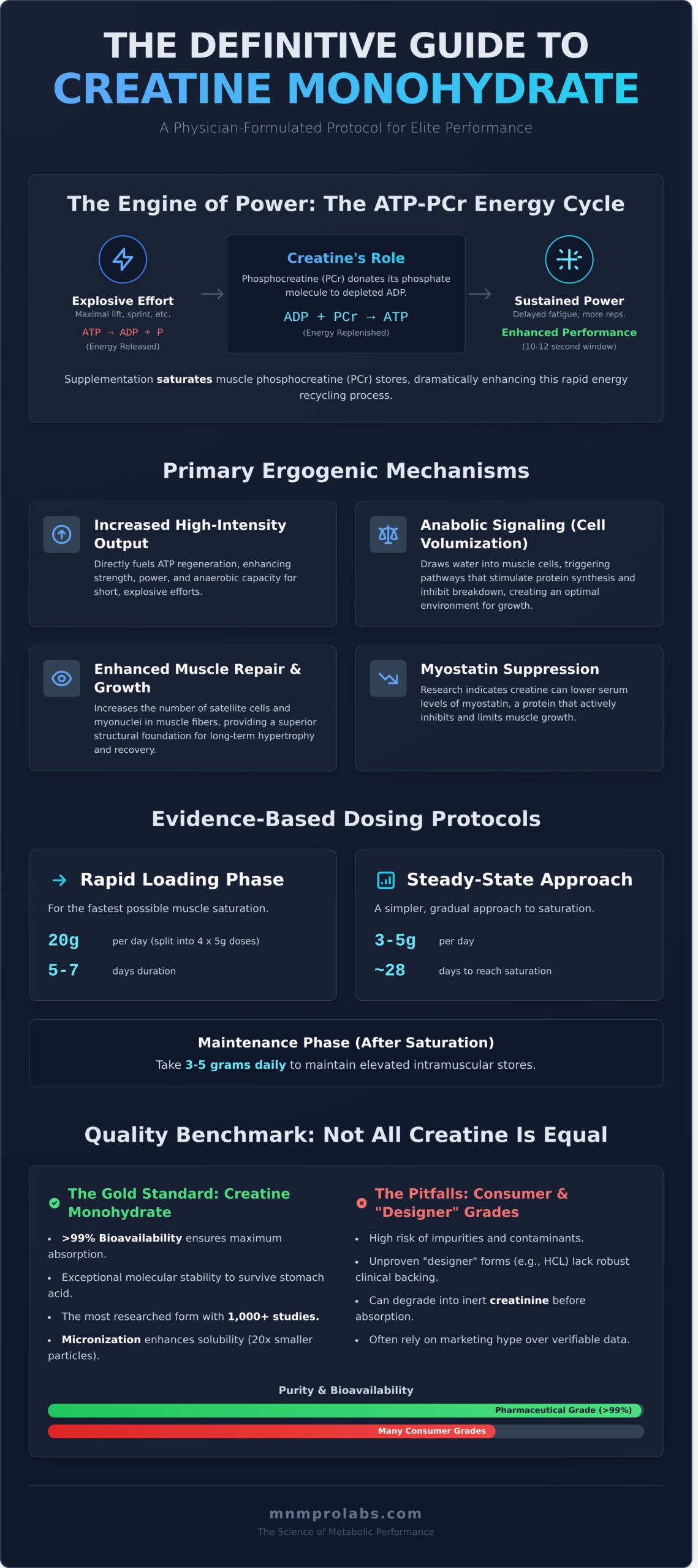
Your body’s capacity for explosive, all-out effort-like a maximal lift or a 40-yard dash-is governed by the phosphocreatine energy system. This system provides the immediate fuel for intense muscular contractions lasting approximately 10-12 seconds. When a muscle contracts, ATP is hydrolyzed into adenosine diphosphate (ADP), releasing a burst of energy. The limitation is that ATP stores are depleted almost instantly. This is where phosphocreatine intervenes, donating its phosphate molecule to ADP to rapidly resynthesize it back into usable ATP. By saturating your muscles with creatine, you expand this phosphocreatine reservoir, directly enhancing your ability to sustain peak power output and delay neuromuscular fatigue.
Bioavailability and Molecular Stability
The market is saturated with “designer” creatine alternatives, yet none have scientifically surpassed the original. The molecular structure of creatine monohydrate, which binds a creatine molecule to a single water molecule, exhibits exceptional stability. This allows it to withstand the acidic environment of the stomach, ensuring over 99% is absorbed into the bloodstream intact. Many newer forms, like creatine HCL, lack the robust clinical backing and can degrade into the inert byproduct creatinine before absorption. For a more detailed look at its biochemistry, this comprehensive overview of creatine provides foundational context. Furthermore, advancements like micronization-a process that reduces particle size by up to 20x-enhance the compound’s solubility and mixability, optimizing the user experience without altering its proven efficacy. With support from more than 1,000 peer-reviewed studies, its position as the most researched sports supplement in history is uncompromising and absolute.
Ergogenic Mechanisms: How Creatine Optimizes Athletic Performance
While celebrated for its role in explosive strength, the true value of creatine monohydrate lies in its complex, multi-system impact on the elite athlete. Its mechanisms extend far beyond simple energy replenishment, influencing everything from cellular hydration and gene expression to cognitive function under duress. The primary function involves saturating intramuscular phosphocreatine (PCr) stores, which serve as a rapid phosphate donor to regenerate ATP, the body’s principal energy currency. This immediate energy buffer is critical for anaerobic performance in events lasting less than 30 seconds. This foundational benefit is widely recognized, and you can find an evidence-based perspective on creatine from leading institutions like the Mayo Clinic that confirms its efficacy.
However, for the high-performance athlete, the secondary mechanisms are where creatine truly differentiates itself. One of its most powerful effects is inducing osmotic swelling, or cell volumization. As creatine accumulates inside the muscle cell, it draws water in with it. This cellular expansion is not merely “water weight”; it acts as a powerful anabolic trigger, initiating a cascade of signaling pathways, including MAPK, that stimulate protein synthesis and inhibit protein breakdown. This process creates a superior physiological environment for muscle growth.
Hypertrophy and Satellite Cell Signaling
Creatine’s influence on muscle growth is profoundly linked to satellite cell activity. These muscle stem cells are crucial for repair and hypertrophy. Studies demonstrate that creatine supplementation, combined with resistance training, increases the number of satellite cells and myonuclei in muscle fibers. This enhanced capacity for repair and growth provides a structural foundation for long-term strength gains. Furthermore, research from a 2010 study in the Journal of Molecular and Cellular Endocrinology indicates creatine can suppress serum levels of myostatin, a protein that actively inhibits muscle growth, effectively unlocking greater hypertrophic potential.
Metabolic Efficiency and Fatigue Mitigation
Beyond raw power, creatine optimizes how your body manages energy and resists fatigue. By enhancing the PCr energy buffer, it reduces the reliance on anaerobic glycolysis during intense, repeated efforts. This directly results in lower accumulation of metabolic byproducts like lactate and hydrogen ions, which contribute to the “burn” and muscular fatigue. This mechanism allows an athlete to sustain a higher work output for longer. Additionally, this improved energy efficiency can lead to glycogen sparing, preserving crucial carbohydrate stores for sustained performance and accelerating post-exercise recovery by mitigating markers of muscle damage and inflammation.
This intricate biochemical cascade, from cellular swelling to metabolic buffering, underscores why the purity of your supplement is non-negotiable. To ensure these mechanisms function optimally, explore our uncompromising, third-party tested creatine formulations designed for the elite performer.
Pharmaceutical Grade vs. Consumer Grade: The MNM Quality Benchmark
For the elite performer, not all supplements are created equal. The market is saturated with low-cost options that compromise purity for profit, a gamble you can’t afford to take. While a cheap tub of creatine monohydrate might seem like a bargain, it often conceals a payload of industrial contaminants that can sabotage performance and long-term health. The difference between a consumer-grade product and a professional-grade formulation isn’t a matter of marketing; it’s a fundamental commitment to safety, efficacy, and purity. This is the standard we set for every product in the MNM ProLabs Shop.
Inferior manufacturing processes can introduce a host of unwanted byproducts. These aren’t just benign fillers; they are potentially harmful substances. Common contaminants in low-grade creatine include:
- Heavy Metals: Trace amounts of lead, arsenic, and mercury can accumulate in the body over time, posing significant health risks.
- Creatinine: A metabolic waste product that offers no performance benefit. High levels indicate poor quality control and an unstable product.
- Dicyandiamide (DCDA): A manufacturing byproduct that serves as a clear marker of subpar synthesis methods. Its presence signals a lack of purification.
To eliminate these risks, elite supplementation demands production in FDA-registered, cGMP (Current Good Manufacturing Practice) certified facilities. This isn’t an optional luxury; it’s the absolute baseline for ensuring what’s on the label is precisely what’s in the bottle.
Third-Party Testing and Purity Transparency
A Certificate of Analysis (CoA) is your proof of purity. This document, provided by an independent laboratory, verifies a product’s identity, potency, and freedom from contaminants. Look for a purity level of 99.9% or higher. For drug-tested athletes, NSF Certified for Sport® is the gold standard, guaranteeing that a product is free from over 270 substances banned by major athletic organizations. At our Tampa-based operations, we enforce strict protocols to ensure zero cross-contamination, protecting the integrity of our professional-grade supplements and the careers of the athletes who trust them.
Physician-Formulated vs. Bro-Science Formulations
Our formulations are born from clinical data, not gym floor anecdotes. A physician-formulated supplement is built on a foundation of scientific rigor, with every ingredient and dosage selected for its proven physiological impact. This clinical approach analyzes metabolic pathways and synergistic effects, referencing peer-reviewed data like this in-depth scientific study to optimize bioavailability and performance outcomes. We reject the deceptive practice of “proprietary blends,” which are often used to hide ineffective, under-dosed ingredients. As a veteran-owned company, our commitment to discipline and uncompromising standards is absolute. It’s a promise of transparency and efficacy, ensuring you fuel your body with precision-engineered tools for elite performance. Explore our commitment to science-backed results in the MNM ProLabs collection.
The Evidence-Based Protocol: Loading, Maintenance, and Synergy
Understanding the cellular mechanisms of creatine is only the first step. Translating that knowledge into a precise, actionable protocol is what separates elite performers from the merely informed. The objective is singular: to achieve and maintain full intramuscular creatine saturation. This is the physiological state where the ergogenic benefits of creatine-enhanced power output, increased work capacity, and accelerated recovery-are fully expressed.
Two primary strategies exist for reaching this state. The choice depends entirely on your performance timeline.
- The Loading Protocol: This involves ingesting 20 grams per day, typically split into four 5-gram doses, for 5-7 consecutive days. This method rapidly saturates muscle stores, achieving peak levels in approximately one week. It is the preferred approach for athletes with an impending competition or those seeking the fastest possible performance gains.
- The Maintenance Protocol: A simpler approach involves supplementing with a consistent 3-5 grams per day from the outset. While this method is equally effective, it takes longer to achieve full saturation, typically around 28 days. This is an ideal strategy for long-term athletic development without a pressing deadline.
Contrary to outdated “bro-science,” there is no scientific basis for cycling creatine. The performance benefits are directly tied to sustained elevation of intramuscular creatine stores. Discontinuing supplementation leads to a gradual decline back to baseline levels over several weeks, effectively nullifying the benefits you’ve worked to achieve. A daily maintenance dose of 3-5 grams is sufficient to maintain full intramuscular saturation for the long term.
Synergistic Pairing for Enhanced Uptake
To optimize the transport of creatine from the bloodstream into the muscle cell, it’s crucial to leverage the hormone insulin. Co-ingesting creatine with a source of carbohydrates or protein, which elicits an insulin response, has been shown to enhance creatine accumulation by up to 60%. This is why pairing your daily dose with a strategically formulated pre-workout can create a powerful ergogenic synergy. The components in a pro-grade formula like the MNM Pre-Workout are designed to support nutrient transport, amplifying the uptake and efficacy of your creatine supplementation.
While debate exists regarding optimal timing, the performance difference between pre- and post-workout ingestion is marginal. The most critical factor remains daily consistency. Choose the time you won’t forget.
Hydration and Metabolic Management
Because creatine pulls water into the muscle cell-a process known as cell volumization-maintaining optimal hydration is non-negotiable. A clinical best practice is to increase daily water intake by an additional 12-16 ounces for every 5 grams of creatine consumed. Minor bloating, a side effect sometimes reported during the loading phase, is often a result of poor solubility. This can be completely mitigated by choosing a high-purity, micronized form of creatine monohydrate, which offers superior dissolution and absorption.
Concerns about long-term safety, particularly regarding renal health, have been definitively addressed by decades of research. A landmark 2026 meta-analysis in the International Journal of Sport Nutrition and Exercise Metabolism, reviewing over 20 years of data, confirmed that long-term supplementation in healthy individuals poses no risk to kidney function. The data is clear: when sourced from a reputable, third-party tested supplier, creatine is one of the safest and most effective performance supplements available. Ensure your protocol is built on a foundation of uncompromising quality by exploring the MNM ProLabs pro-grade creatine formulation.
The MNM Advantage: Precision-Engineered Creatine for Elite Performers
Theoretical understanding of an ergogenic aid is insufficient for the analytical athlete. True optimization demands empirical proof and uncompromising quality in application. MNM ProLabs was founded on this principle, forged at the intersection of veteran discipline and physician-led biochemical research. We don’t just sell supplements; we engineer nutritional instruments for those who measure progress in millimeters and milliseconds.
Our Tampa-headquartered team operates on a simple, yet radical premise: “industry standard” is a benchmark for mediocrity. While many brands are content with baseline purity levels, our internal mandate targets a higher threshold, systematically eliminating impurities that can hinder metabolic efficiency. This relentless pursuit of quality is a direct reflection of the mindset we serve. Elite performers don’t settle for average in their training, so why should they accept it in their nutrition?
The Science Behind MNM Creatine Monohydrate
Our formulation begins with a superior raw material, which is then subjected to a rigorous micronization process. By milling the particles to an exceptionally fine 200 mesh powder, we dramatically increase the supplement’s surface area. This structural enhancement facilitates superior solubility and, more critically, optimizes its uptake in the digestive tract. The result is maximum bioavailability, ensuring every gram is efficiently absorbed to saturate intramuscular phosphocreatine stores without the gastrointestinal distress common with inferior products.
Every batch of our creatine monohydrate is subject to a stringent, multi-stage quality control protocol that culminates in verification by an independent, third-party laboratory. These labs test for not only purity and potency but also for a full panel of potential contaminants, including heavy metals, microbes, and banned substances. We make these lab reports available because transparency isn’t a marketing tactic; it’s a non-negotiable component of our operational DNA.
We’ve deliberately structured MNM ProLabs as a direct-to-consumer brand. This model eliminates the financial burden of retail intermediaries and distributor markups, which can often inflate the final price by 40-60%. By managing our supply chain from formulation to fulfillment, we deliver a pro-grade, physician-formulated product directly to you, ensuring premium quality is not a luxury but a strategic investment in your performance.
Join the Community of Elite Performers
Choosing MNM ProLabs means joining a select community of athletes, operators, and high-achievers who prioritize data over dogma. We support your journey toward physical excellence with educational resources grounded in scientific literature and a commitment to product innovation that keeps pace with your ambition. Your goals are our mission.
We understand that consistency is the cornerstone of any successful training protocol. To ensure you never miss a dose, our operations are supported by multi-region logistics centers across the United States. This strategic distribution network guarantees fast, reliable fulfillment, getting our precision-engineered supplements into your hands exactly when you need them.
Stop guessing and start optimizing. The data is clear, and the standard for quality has been set. Elevate your physical potential with nutrition engineered for the top tier of human performance. Optimize your performance-Shop MNM Creatine Monohydrate today.
Execute Your Protocol with Uncompromising Purity
The scientific evidence is definitive. For athletes committed to metabolic optimization, the question isn’t if you should supplement, but how. Its role as a foundational ergogenic aid directly translates to measurable gains in strength and power output. However, the efficacy of any protocol hinges entirely on the quality of the compound, and not all creatine monohydrate is engineered to the same exacting standard.
This is where discipline meets data. MNM ProLabs was founded on the principle that your body is a high-precision machine demanding equally refined fuel. Our formula is Physician Formulated for optimal bioavailability and is produced in a cGMP Certified facility. To guarantee absolute purity, every single batch is rigorously Third-Party Tested, delivering a standard of transparency you can trust from a Veteran Owned & Operated company.
Don’t compromise your results with an inferior product. It’s time to align your supplementation with your ambition. Invest in Elite Purity-Shop MNM Creatine Monohydrate and experience the definitive advantage in your training. Your peak performance is waiting.
Frequently Asked Questions About Creatine Monohydrate
Is a creatine loading phase absolutely necessary for results?
No, a creatine loading phase isn’t necessary, but it significantly accelerates the time required to achieve full muscle saturation. A loading protocol of 20 grams per day for 5-7 days saturates muscle phosphocreatine stores in approximately one week. In contrast, a standard maintenance dose of 3-5 grams daily will achieve the identical saturation level in about 28 days. The end result is the same; loading simply expedites the initial ergogenic benefits for athletes demanding immediate performance optimization.
Does creatine monohydrate cause hair loss according to recent studies?
No, the body of scientific evidence does not establish a causal link between creatine supplementation and hair loss. This concern originates from a single 2009 study that noted an increase in dihydrotestosterone (DHT). However, this study has not been replicated in over a decade of subsequent research, and the observed DHT levels remained within normal clinical ranges. The International Society of Sports Nutrition (ISSN) concludes there is no definitive scientific evidence to support this claim for hair loss.
Can I take creatine if I am focused on fat loss and “cutting”?
Yes, creatine is a highly effective ergogenic aid during a fat loss or “cutting” phase. Its primary function is to support high-intensity training capacity and preserve lean muscle mass, both of which are critical goals during a caloric deficit. Creatine increases intramuscular water retention, which is physiologically distinct from the subcutaneous water retention or fat gain that can obscure definition. By helping you maintain strength and training intensity, it directly supports your metabolic objective of preserving muscle.
What is the difference between creatine monohydrate and creatine HCL?
The principal difference is their chemical structure and solubility, not their proven performance efficacy. Creatine HCL (hydrochloride) is bonded with a hydrochloride group to increase its solubility in water. While proponents claim this enhances absorption, creatine monohydrate is supported by over 1,000 clinical studies confirming its near-total bioavailability (over 99%) and unparalleled ergogenic effects. To date, creatine HCL lacks the extensive research required to validate claims of its superiority for strength or power output.
Is it safe to take creatine monohydrate every day without a break?
Yes, extensive scientific literature confirms that continuous daily supplementation with creatine monohydrate is safe for healthy individuals. The concept of “cycling” creatine is an outdated protocol with no scientific basis for its necessity. Long-term studies, with some lasting up to five years, have demonstrated no adverse effects from consistent daily intake of 3-5 grams. The ISSN supports its long-term safety and efficacy, making continuous use the superior protocol for sustained performance benefits.
How much water should I drink while taking creatine?
You should aim to maintain optimal hydration by consuming a minimum of 3-4 liters (approximately 100-135 ounces) of water daily. Creatine functions by drawing water into muscle cells to support ATP regeneration, a process known as cell volumization. To facilitate this physiological mechanism and ensure proper systemic fluid balance, a deliberate increase in water intake is advised. A sound protocol is adding an extra 0.5-1 liter of water above your typical daily consumption.
Does creatine interact poorly with caffeine in my pre-workout?
No, the overwhelming scientific consensus indicates that creatine and caffeine can be consumed together without negating their respective benefits. While a single, older study from 1996 suggested a potential blunting effect, dozens of more robust, modern trials have failed to replicate this finding. In fact, most research shows either synergistic or independent performance benefits. For the vast majority of elite athletes, co-ingestion poses no threat to performance optimization and is considered an effective strategy.
Is creatine monohydrate safe for high-performance teen athletes?
Yes, when used correctly within a structured program, creatine is considered safe and effective for adolescent athletes. The International Society of Sports Nutrition (ISSN) position stand from 2017 affirms that creatine supplementation is acceptable for younger athletes who are involved in serious, supervised training; consume a well-balanced, performance-enhancing diet; and are knowledgeable about its effects. It must be used to enhance training, not as a substitute for proper nutrition. Consultation with a physician is always the first step.
Disclaimer
Content on the MNM ProLabs Blog is provided for informational and educational purposes only and should not be considered medical advice. Always consult a qualified healthcare professional before making changes to your health, diet, training, or supplementation routine. Statements regarding supplements have not been evaluated by the FDA and are not intended to diagnose, treat, cure, or prevent any disease.