A 2023 market analysis revealed that nearly 48% of leading sports nutrition products still utilize “matrix” labels to obscure their exact ingredient ratios. You’ve likely felt the frustration of investing $65 in a premium formula only to experience zero physiological response. It’s exhausting to wonder if your performance plateaus are due to your training or simply under-dosed ingredients. Learning how to avoid proprietary blends in supplements is the only way to stop wasting capital on “fairy dusted” products that prioritize profit margins over your metabolic optimization.
We understand that elite performance requires pharmaceutical-grade precision. This guide provides the clinical methodology needed to identify hidden blends so you can ensure your supplements deliver precise, effective dosages for peak performance. You’ll gain the ability to decode any supplement label in under 25 seconds while learning the specific clinical benchmarks for key ergogenic aids like Beta-Alanine and Betaine Anhydrous. We’re moving past the marketing hype to focus on the raw data that drives results. By the end of this article, you’ll know exactly how to vet a brand for medical-grade transparency and demand the purity your training deserves.
Key Takeaways
- Uncover the legal loopholes within the DSHEA 1994 that allow manufacturers to mask specific ingredient ratios behind a single “matrix” or “complex” weight.
- Master the clinical methodology on how to avoid proprietary blends in supplements by identifying specific “sourcing words” that signal a lack of formula transparency.
- Learn to cross-reference total blend weights with ingredient counts to ensure your body receives the minimal effective dose required for metabolic optimization.
- Identify the “stimulant mask” tactic, where high caffeine levels are used to disguise sub-clinical dosages of critical performance-enhancing ingredients.
- Implement a rigorous 4-step vetting protocol to transition from standard consumer-grade products to physician-formulated, transparent supplements.
Understanding Proprietary Blends: The DSHEA 1994 Loophole
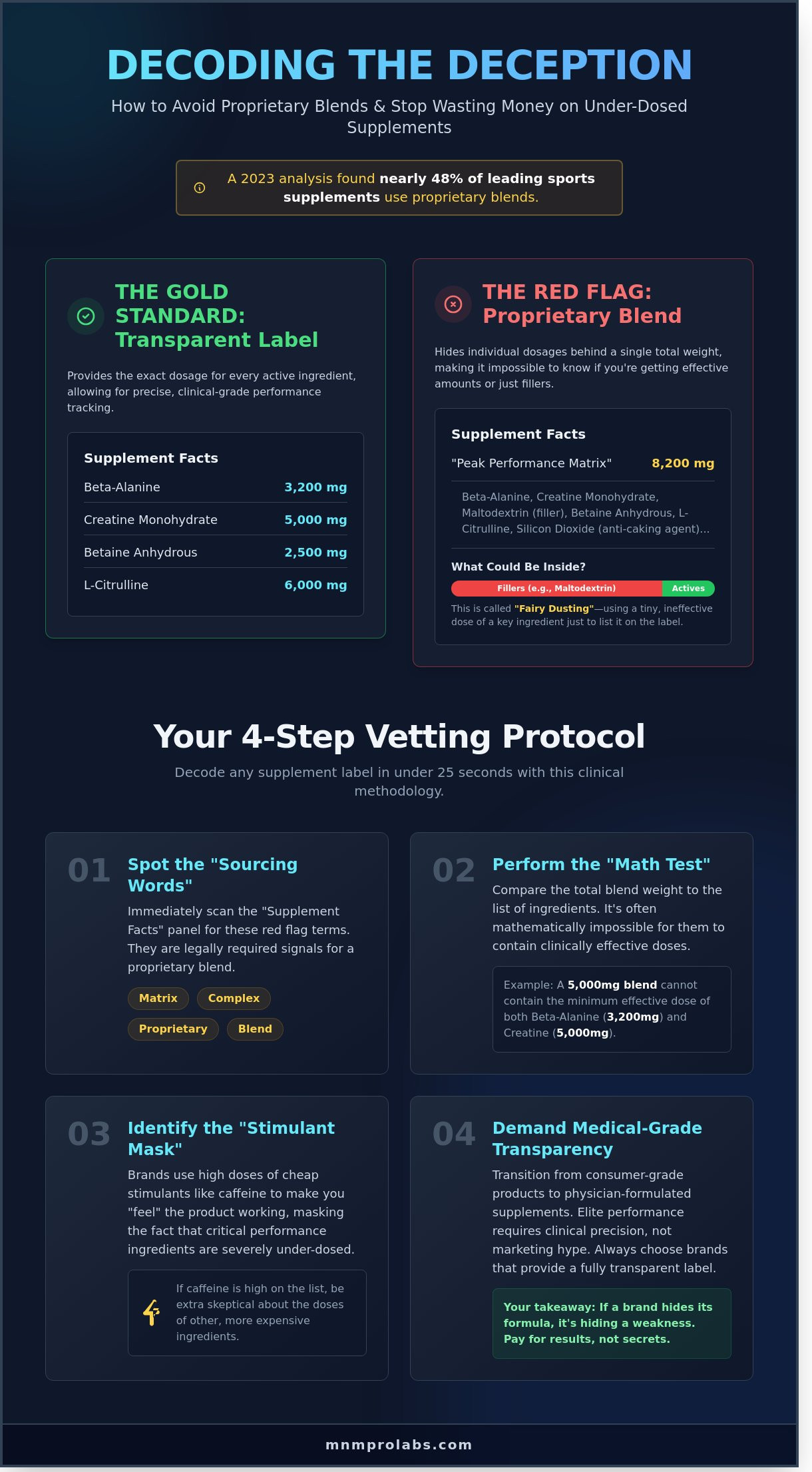
A proprietary blend is a collective “matrix” or “complex” of ingredients where the manufacturer lists only the total weight of the combined components. This practice intentionally obscures the individual dosage of each active ingredient. Understanding this labeling tactic is the first step in learning how to avoid proprietary blends in supplements. While a label might claim 5,000mg of a “Performance Matrix,” it provides zero clarity on whether you are receiving 4,990mg of cheap maltodextrin and only 10mg of a critical ergogenic aid like Creatine Monohydrate. This lack of data makes it impossible to track your intake with precision.
The legal precedent for this lack of transparency stems from the Dietary Supplement Health and Education Act of 1994. This legislation allows brands to omit specific ingredient quantities under the guise of protecting “trade secrets.” In reality, this loophole serves as a shield for profit margins rather than intellectual property. For elite athletes, this obfuscation prevents precise metabolic optimization and compromises safety. Without knowing the exact ratios, you cannot predict how a formula will interact with your unique physiology or other components of your stack.
To better understand this concept, watch this helpful video:
The Difference Between a Transparent Label and a Blend
Transparent labels provide the exact milligram or gram count for every active ingredient. This allows users to verify that dosages align with peer-reviewed clinical studies. In contrast, blends list ingredients in descending order of weight. You know what is in the bottle, but you don’t know the concentration. This is why physician-formulated supplements prioritize transparency. These formulas must meet rigorous clinical standards; this requires disclosing every metric for accountability and performance tracking. Professional grade products never hide behind vague terminology.
Why the Industry Relies on Obfuscation
The supplement industry often uses “fairy dusting” to maximize profits. This involves adding an expensive, high-quality ingredient at a fraction of its effective dose just to list it on the label. Brands then use marketing hype to create exclusive-sounding names for these blends. This tactic distracts consumers from a lack of clinical data. By hiding the ratios, companies avoid accountability for failed results or adverse reactions. They protect their bottom line by filling capsules with cheap bulkers while charging a premium price. Learning how to avoid proprietary blends in supplements ensures you pay for actual performance, not marketing fillers.
How to Read Supplement Labels to Identify Hidden Blends
Learning how to avoid proprietary blends in supplements requires a clinical eye for detail. You must look past the bold marketing on the front of the bottle and scrutinize the Supplement Facts panel for specific “Sourcing Words.” Terminology like Matrix, Complex, Proprietary, or Blend act as immediate red flags; they signal that the manufacturer is grouping ingredients together to hide individual dosages. Precision is the hallmark of elite performance, and these vague terms are the antithesis of pharmaceutical-grade standards.
Analyze the Total Weight of the blend against the number of ingredients listed. If a proprietary blend has a total weight of 5,000mg but contains 12 different compounds, the math for clinical dosing rarely adds up. For instance, an effective dose of Beta-Alanine is typically 3.2g, and Creatine Monohydrate requires 5g for saturation. This scientific perspective on proprietary blends illustrates how these “black box” formulas often leave athletes with sub-therapeutic amounts that fail to trigger the desired physiological response.
Always check the Other Ingredients section located below the main panel. Identify where fillers, artificial colors, and flow agents like magnesium stearate or silicon dioxide are listed relative to the active ingredients. A transparent brand will also volunteer a Total Disclosure seal or third-party verification from organizations like NSF or Informed Choice to prove their label accuracy. For those who demand uncompromising quality, you can shop our fully transparent formulas to see exactly what goes into every serving.
Spotting the ‘Fairy Dusting’ Technique
Fairy dusting is the practice of including a popular ingredient at a sub-therapeutic level for marketing purposes. You’ll often see high-value compounds like L-Citrulline or Creatine listed at the very end of a long blend. If an ingredient is listed 5th in a 2,000mg complex, it’s physically impossible for it to reach a clinical dose. This tactic allows brands to claim the ingredient is present without providing the actual performance benefit. This deceptive labeling is a major reason why serious athletes prioritize transparency over hype.
Decoding ‘Complex’ Terminology in Sports Nutrition
Common naming conventions in sports nutrition are often designed to sound scientific while masking a lack of quality. You must differentiate between a legitimate synergistic formula, where ingredients are chosen to enhance one another, and a proprietary mask used to protect “trade secrets.” Look for specific salt forms on the label. A transparent manufacturer will list Creatine Monohydrate or Caffeine Anhydrous rather than just “Creatine” or “Caffeine.” This level of specificity ensures maximum bioavailability and metabolic optimization for the elite performer.
The Performance Cost of Sub-Clinical Dosing
Biological systems operate on strict thresholds. If an ergogenic aid fails to reach its minimal effective dose, the physiological response is zero. This isn’t a sliding scale; it’s a binary outcome. Many manufacturers hide behind “proprietary” labels to mask the fact that their formulas are sub-clinical. They often rely on a “stimulant mask” by loading a product with 300mg or 400mg of caffeine. You feel energized, yet your muscle tissue lacks the actual cellular support needed for hypertrophy or endurance. Learning how to avoid proprietary blends in supplements ensures you aren’t paying for expensive, flavored caffeine that offers no real structural benefit.
Elite athletes require data, not marketing hype. Missing out on the cumulative benefits of ingredients like L-Glutamine or BCAAs due to chronic underdosing halts long-term recovery. When you guess your intake, you’re essentially gambling with your metabolic optimization. Precision nutrition requires knowing exactly what enters your system to manage systemic load and performance output. Professionals don’t settle for “blends” because they understand that a 500mg deficit in a key amino acid can be the difference between a PR and a plateau.
Case Study: Underdosed Pre-Workouts
Consider a standard “Proprietary Pump Blend” totaling 2,000mg. To trigger significant nitric oxide production and metabolic waste clearance, peer-reviewed research confirms a physiological requirement of 6g to 8g of Citrulline Malate. A 2g blend is mathematically incapable of providing the 6,000mg needed for effective vasodilation. Choosing a transparent pre-workout ensures every milligram serves a functional purpose. Without this precision, you’re left with a temporary buzz rather than a genuine ergogenic edge.
The Accumulative Effect of Precision Nutrition
Consistent, clinical dosing is the only path to chronic adaptations in muscle tissue. Proprietary guessing games lead to training plateaus because the body cannot adapt to inconsistent nutrient signals. Understanding how to identify proprietary blends is the first step in protecting your long-term health. Overdosed stimulants paired with underdosed recovery agents create unnecessary metabolic stress and gut irritation. Transparency allows for the precise titration of nutrients, ensuring your body functions like a high-precision machine. When you know how to avoid proprietary blends in supplements, you gain total control over your metabolic environment and recovery trajectory.
A 4-Step Protocol to Avoid Proprietary Blends in Your Regimen
Adopting a transparent supplementation strategy is a requirement for anyone treating their body like a high-precision machine. You’re moving away from the “bro-science” of hidden dosages toward a clinical, data-driven approach. This protocol ensures you know exactly what fuels your metabolic optimization. Understanding how to avoid proprietary blends in supplements starts with demanding a weight for every line item on the label.
- Step 1: Inspect for Absolute Transparency. Look at the Supplement Facts panel. Every ingredient must have a specific weight in milligrams or grams. If a label groups ten ingredients under a “Performance Complex,” you can’t determine the efficacy of a single one.
- Step 2: Cross-Reference with Clinical Research. Match the listed weights against peer-reviewed ergogenic standards. If a pre-workout contains 1,000mg of Creatine Monohydrate but the research shows 5,000mg is needed for saturation, the product is underdosed.
- Step 3: Verify Manufacturing Credentials. Look for markers indicating the product was made in an FDA-registered and cGMP-certified facility. These certifications mean the manufacturer follows strict protocols to ensure the dosage on the label matches the contents of the container.
- Step 4: Demand Third-Party Lab Results. Access the Certificate of Analysis (CoA). This document proves the product has been tested for purity, potency, and the absence of contaminants like heavy metals or banned substances.
Verifying Clinical Dosages via Independent Research
Reliable data on ingredient thresholds is readily available via platforms like Examine.com or PubMed. For those prioritizing recovery, look for Essential Amino Acids (EAAs) at dosages of at least 6 to 10 grams. Your activity level dictates your specific requirement; an elite athlete training 10 hours a week requires higher metabolic support than a sedentary individual. Mastering how to avoid proprietary blends in supplements requires you to build a personalized standard based on these clinical benchmarks.
Evaluating Brand Integrity and Ownership
Physician-led or veteran-owned brands typically uphold higher transparency standards because their reputation is tied to clinical outcomes, not just marketing cycles. A “No Artificial Fillers” claim is often a marker of a premium, clean formula that avoids maltodextrin or unnecessary silicon dioxide. If a brand refuses to provide an ingredient breakdown when asked directly, it’s a clear signal to look elsewhere. Pro-grade labs welcome the scrutiny because their formulations are built on empirical evidence.
Ready to upgrade to a regimen defined by clinical precision and total transparency? Shop our pro-grade sports nutrition formulas here.
Why MNM ProLabs Prioritizes Uncompromising Transparency
Performance is a game of margins. At MNM ProLabs, we treat the human body as a high-precision machine that requires pharmaceutical-grade fuel to function at its peak. We’ve moved beyond standard consumer-grade products to physician-formulated standards that prioritize medical-grade precision. Our commitment to the athlete is absolute: 100% label transparency with zero proprietary blends. We believe you deserve to know the exact dose of every ergogenic aid entering your system.
Mastering how to avoid proprietary blends in supplements requires a brand that values data over marketing hype. We manufacture our entire line in FDA-registered, GMP-certified facilities to ensure the highest manufacturing rigor. Every batch undergoes third-party testing to verify that the purity on the label matches the contents of the bottle. This uncompromising approach is why top-tier athletes and professionals trust our formulas. They don’t have room for error, and neither do we.
Our Lab-to-Life Methodology
Our formulation process focuses heavily on bioavailability and synergistic optimization. We don’t just select ingredients based on popularity; we analyze how they interact at a cellular level to maximize metabolic uptake. Both our wellness and performance lines are built on empirical evidence and clinical research. This level of discipline is maintained by our military veteran and physician-led team. We apply tactical rigor to biochemistry, ensuring our pro-grade standards deliver repeatable, elite results for every user.
Join the Elite: Choosing Performance Over Hype
There’s a significant psychological benefit to knowing exactly what fuels your high-precision machine. When you eliminate the guesswork, you gain the confidence to push your physiological limits. Transparency builds a genuine partnership between the brand and the performer. We provide the data, and you provide the work. This relationship is built on trust, not “magic” formulas or hidden ingredients.
It’s time to take control of your nutrition. Audit your current supplement stack for hidden blends and vague “complexes.” If a manufacturer won’t disclose their dosages, they’re likely masking an under-dosed product. Don’t settle for average formulations when you’re striving for elite status. Choose the precision, purity, and power of MNM ProLabs to fuel your journey toward peak physical condition.
Master the Science of Label Transparency
The DSHEA 1994 loophole has allowed the industry to hide behind “blends” for nearly 30 years, often resulting in sub-clinical dosing that stalls your progress. By mastering how to avoid proprietary blends in supplements, you reclaim control over your metabolic optimization. You’ve learned that a transparent label is the only way to verify you’re receiving ergogenic aids at their effective, 6,000mg or 3,200mg thresholds rather than paying for under-dosed fillers. Elite performance isn’t built on guesswork; it’s built on the precise application of biochemistry.
MNM ProLabs sets the standard for clinical integrity. Our physician-formulated formulas are manufactured in FDA-registered facilities and undergo strict third-party testing for purity. We provide the data your body requires to perform at its peak, ensuring every milligram serves a physiological purpose. Don’t settle for the ambiguity of consumer-grade products when you can utilize pro-grade standards.
Shop our 100% transparent, physician-formulated supplements at MNM ProLabs
Your commitment to excellence deserves a formula that works as hard as you do.
Frequently Asked Questions
Is it illegal for a supplement company to use a proprietary blend?
No, it is entirely legal under the Dietary Supplement Health and Education Act (DSHEA) of 1994. FDA regulations allow manufacturers to list a “blend” total weight without disclosing individual ingredient amounts. While legal, this practice often obscures the clinical efficacy of the formula. Elite athletes should look for brands that exceed these 1994 standards by providing full label transparency and pharmaceutical-grade precision.
Can a proprietary blend still be a high-quality product?
It’s possible for a blend to contain quality raw materials, but you cannot verify the metabolic optimization without knowing the exact dosages. A product might use premium Citrulline Malate, but if the dose is 500mg instead of the clinically studied 6,000mg, the quality of the source becomes irrelevant. Purity doesn’t compensate for a lack of ergogenic potency; transparency is the only way to ensure you’re receiving a pro-grade supplement.
How do I know if an ingredient in a blend is underdosed?
You can estimate underdosing by checking the total weight of the blend against the position of the key ingredients. Ingredients are listed in descending order by weight. If a 1,000mg blend lists Creatine Monohydrate first and Beta-Alanine second, it’s mathematically impossible for both to reach clinical levels. Knowing how to avoid proprietary blends in supplements helps you identify these mathematical impossibilities before you waste your capital on ineffective formulas.
What is ‘fairy dusting’ in the supplement industry?
Fairy dusting is the practice of adding a negligible amount of a “hype” ingredient to a formula solely for marketing purposes. A company might include 10mg of a branched-chain amino acid (BCAA) when the effective dose for muscle protein synthesis is 5,000mg or higher. This tactic allows the brand to claim the ingredient’s benefits on the front of the bottle while the actual physiological impact remains zero for the consumer.
Why do companies claim proprietary blends protect their ‘intellectual property’?
Brands often use the “intellectual property” defense to prevent competitors from copying their specific ratios. However, most supplement ingredients are well-researched compounds with publicly available clinical data. In 95% of cases, this claim is a shield to hide low-cost manufacturing and high-filler content. True innovation in sports science relies on transparency and peer-reviewed evidence, not hidden recipes that avoid accountability.
Are all physician-formulated supplements free of proprietary blends?
No, the “physician-formulated” label doesn’t guarantee a transparent formula. This term is often used as a marketing hook rather than a certification of clinical dosing. While it implies a higher standard of biochemical oversight, many such products still utilize blends to mask ingredient ratios. You must verify that the product is also manufactured in an FDA-registered, GMP-certified facility and offers a fully disclosed facts panel to ensure safety.
How can I check if a supplement has been third-party tested?
Look for specific certification seals from independent organizations like NSF Certified for Sport, Informed Choice, or USP. These 3rd-party entities verify that the contents match the label and are free of banned substances or contaminants. You can also request a Certificate of Analysis (COA) from the manufacturer. Pro-grade brands typically make these lab results readily available to ensure uncompromising purity and safety for elite performers.
What should I do if my favorite supplement uses a proprietary blend?
Contact the manufacturer directly and ask for the specific breakdown of the active ingredients. If they refuse to provide the data, it’s time to transition to a brand that prioritizes transparency. Learning how to avoid proprietary blends in supplements is about taking control of your performance. Your body is a high-precision machine; it requires exact, pharmaceutical-grade inputs to achieve peak physical condition and metabolic optimization.
Disclaimer
Content on the MNM ProLabs Blog is provided for informational and educational purposes only and should not be considered medical advice. Always consult a qualified healthcare professional before making changes to your health, diet, training, or supplementation routine. Statements regarding supplements have not been evaluated by the FDA and are not intended to diagnose, treat, cure, or prevent any disease.